Yes—you can customize a pizza order for mixed dietary needs when the restaurant confirms the requested ingredients and preparation are possible. Separate pizzas are a clearer choice than split toppings when guests need different crusts or cheese choices. For food allergies or celiac disease, ingredient changes alone do not establish safety; you also need answers about cross-contact before ordering.
- Customize pizza order for mixed dietary needs: confirm ingredients, then choose separate pizzas where requirements differ.
- Wheat and milk restrictions require more than removing visible toppings; preparation matters too.
- Half-and-half pizza suits topping preferences, not protection from allergen cross-contact.
- Sliceofsociety fits Newhall diners seeking New York-style pizza and lounge dining; confirm dietary requests directly.
Can you customize a pizza order for mixed dietary needs?
Yes, but match the customization to the actual restriction—not just the topping someone dislikes. A vegetarian preference, a vegan diet, a milk allergy, and celiac disease require different questions. Calling all of them a special order hides the details the kitchen needs.
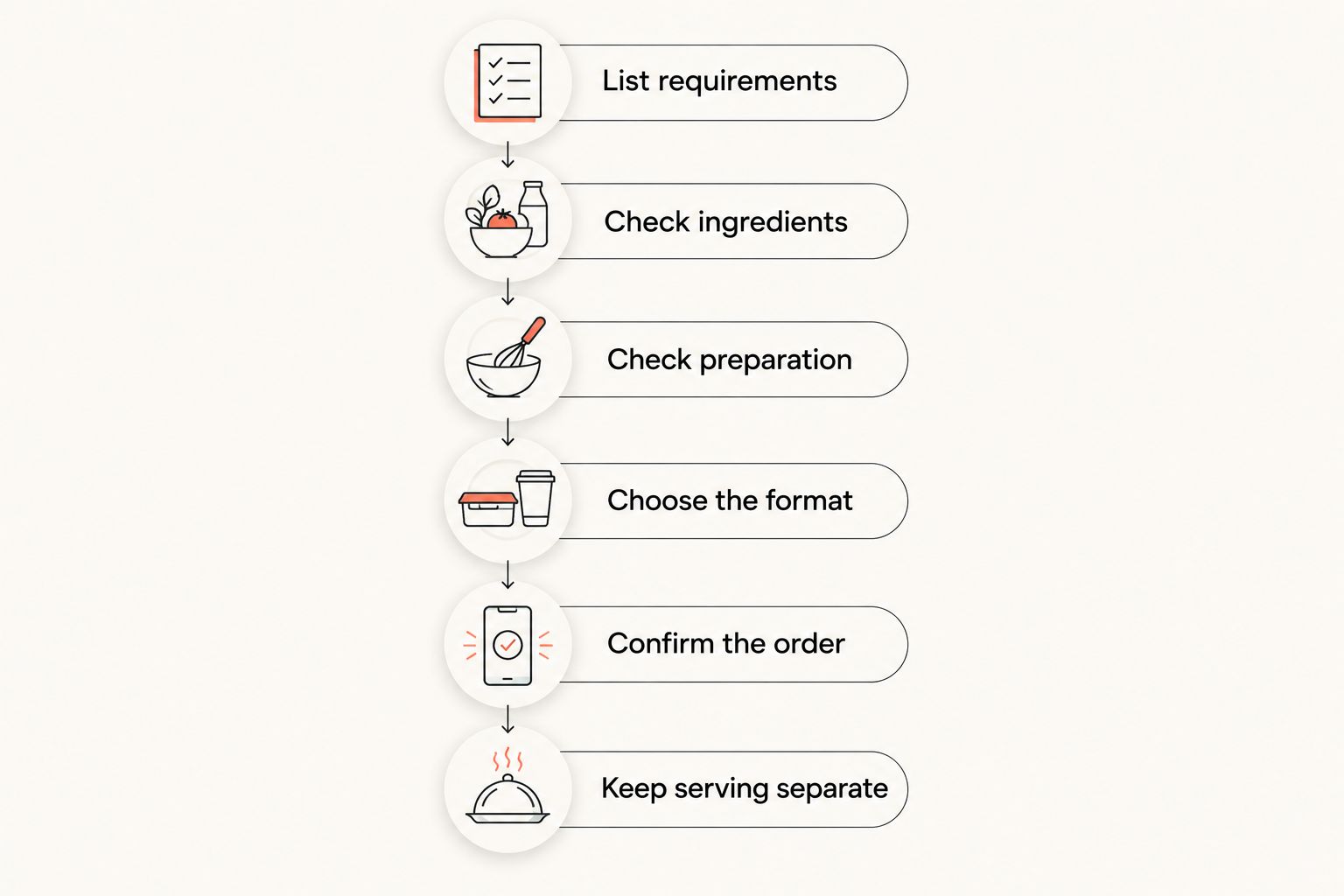
Use this sequence for your 2026 group dinner. If you are coordinating several people, the guide to ordering a custom pizza build for a big group in Newhall addresses the broader ordering task; settle the dietary requirements before choosing the final combinations.
- List requirements. Ask each guest what they avoid and whether the reason is a preference, religious practice, intolerance, allergy, or celiac disease. Record the exact ingredient or category rather than a vague label such as healthy or light.
- Check ingredients. Ask about the crust, sauce, cheese, toppings, and finishing ingredients. A pizza without visible meat is not automatically vegan, and a pizza without cheese is not automatically free of milk ingredients.
- Check preparation. For allergies and celiac disease, ask about shared work surfaces, utensils, cutters, and cooking equipment. Explain that you are asking about cross-contact, not simply requesting an ingredient omission.
- Choose the format. Use split toppings only for compatible preferences. Choose separate pizzas when the guests need different bases or different ingredients throughout, provided the kitchen confirms the requested preparation.
- Confirm the order. Read back each pizza and its requirements. If you order online, do not treat a typed note as confirmation that the kitchen has accepted an allergy-related request.
- Keep serving separate. Ask how the finished orders will be identified, then keep the appropriate serving utensils with each pizza. Let the guest with the restriction verify their food before everyone starts sharing.
The decision point comes before checkout. If the kitchen cannot answer an ingredient or preparation question, do not substitute your own assumption. Choose another meal that the guest and restaurant can confirm meets the requirement.
Why this matters
A good group order gives everyone something they can actually eat. That means distinguishing a request for less cheese from a requirement to avoid milk, or a preference for less wheat from the needs of a guest with celiac disease.
The group organizer should collect the information, not reinterpret it. Ask the guest to describe their own requirement and pass that wording to the restaurant. Nobody should have to explain an allergy for the first time while everyone else reaches for a slice.
For a 2026 dinner plan, keep the dietary conversation separate from the fun decisions. Pick the music, cocktails, and sharing plates after you know which meal choices work. A confirmed meal beats an impressive spread that leaves someone watching everyone else eat.
Which ordering format works best for your group?
Different formats solve different problems. The comparison below describes ordering approaches, not a restaurant's menu or a promise that every kitchen supports each request.
| Ordering approach | Best for | Advantage | Limitation |
|---|---|---|---|
| One shared pizza | Guests whose ingredient requirements match | Keeps the order simple | Everyone must agree on the whole pizza, including crust and sauce |
| Half-and-half toppings | Different topping preferences on the same base | Lets guests share a pizza without identical toppings | Does not separate ingredients during preparation or prevent cross-contact |
| Separate pizzas | Guests with different whole-pizza requirements | Makes ingredients and serving assignments clearer | Separate pizzas do not establish separate kitchen handling |
| Individual meal choices | Guests whose needs do not fit the shared order | Lets each person confirm their own meal | Requires more coordination and a clearly identified order |
Use half-and-half for taste; use a full ingredient and preparation check for dietary restrictions. A topping boundary is not an allergen barrier. Cutting a pizza into separate slices does not change how its crust, sauce, or cheese was handled.
A separate pizza also needs a clear description. Write the intended ingredients and exclusions, not simply a guest's name. Names help with serving; ingredients help the kitchen understand the request.
Vegetarian requests: check more than visible meat
Best for: Guests avoiding meat who can eat the confirmed crust, sauce, cheese, and toppings.
A vegetarian pizza request starts with leaving off meat and seafood, but the whole recipe still matters. Some cheeses use animal-derived rennet, and sauces or finishing ingredients can contain ingredients a particular vegetarian avoids. Ask the guest how they define vegetarian before passing the request along.
The advantage is that guests with compatible requirements can share a meatless pizza without needing the same favorite vegetables. The limitation is that a meatless appearance does not answer every ingredient question.
Keep spice preferences separate from vegetarian requirements. Someone can want a vegetarian pizza and still dislike heat, olives, or heavily dressed toppings. Confirm both the dietary boundary and the flavor choices rather than assuming one explains the other.
Vegan requests: verify the complete recipe
Best for: Guests avoiding animal-derived ingredients across the entire pizza.
A vegan order requires checking the dough, sauce, cheese choice, toppings, and finishing ingredients. Removing dairy cheese is only one part of that review. Ask directly about milk, eggs, honey, and other animal-derived ingredients rather than relying on a vegetable topping list.
The advantage of a fully confirmed vegan build is a clear ingredient specification. The limitation is that omitting one component does not establish that the rest of the recipe meets the same requirement.
For your 2026 order, use the current ingredient information rather than an old menu screenshot. Recipes and suppliers change. A prior visit, a friend's recommendation, or a photograph cannot confirm the composition of the pizza being prepared for this dinner.
Milk restrictions: distinguish intolerance from allergy
Best for: Guests who can describe whether they need to avoid lactose, milk proteins, or dairy ingredients generally.
Lactose intolerance and milk allergy are different conditions. Lactose is a sugar in milk; milk allergy involves an immune response to milk proteins. A lactose-free dairy ingredient is not the same thing as a milk-free ingredient.
A no-cheese request makes the desired omission easy to understand. Its limitation is equally important: milk ingredients can occur elsewhere in a recipe, and removing cheese does not address shared preparation equipment.
Let the guest state their requirements. Do not tell someone with a milk allergy that a small amount is acceptable or that removing cheese after baking solves the problem. The kitchen needs the allergy information before preparation, not an improvised correction at the table.
Gluten restrictions: ask about ingredients and handling
Best for: Guests who need a clear distinction between avoiding gluten by preference and managing celiac disease or another medical restriction.
Gluten-free ingredients do not, by themselves, establish that a finished pizza is suitable for someone with celiac disease. Ask about the base and every added ingredient, then discuss flour exposure, work surfaces, utensils, and cooking equipment with the restaurant.
A separate base, if the kitchen confirms it can provide one, addresses an ingredient difference. The limitation is that separate ingredients do not prove separate handling. A dedicated-looking pizza box tells you nothing about preparation.
For a 2026 gathering, let the guest with celiac disease evaluate the restaurant's answers. Do not replace that judgment with reassurance from the rest of the group. If the preparation cannot be confirmed, choose a different meal rather than describing the pizza as safe.
Why pizza customization varies
The important differences come from the recipe and the preparation process, not how neatly the request fits into an order note.
- Base ingredients: Crust and sauce form the foundation of every slice. A topping change cannot remove an ingredient already present in either component.
- Compound ingredients: Cheese, sauces, and prepared toppings can contain ingredients that are not obvious from the menu description. Ask about the complete ingredient information.
- Kitchen handling: Shared surfaces, utensils, cutters, and cooking equipment matter when the requirement includes avoiding cross-contact. Separate orders alone do not answer those questions.
- Ordering channel: An online customization field records a request; it does not establish that staff reviewed and accepted it. Confirm medical restrictions directly before submitting the order.
- Serving setup: Shared utensils and topping transfers can undo the separation you arranged. Keep the identified meals and their serving tools together.
These are questions to resolve, not reasons to abandon dinner. Start with the strictest requirement, establish a workable meal for that guest, and build the rest of the order around it.
Can half-and-half pizza accommodate different dietary needs?
Half-and-half pizza accommodates compatible topping preferences, not allergen separation. Both halves share the base and preparation environment. Use it when guests agree on the underlying ingredients and simply want different toppings.
Is a separate pizza enough for someone with a food allergy?
A separate pizza does not establish allergy safety. The kitchen still needs to confirm the ingredients and explain its cross-contact controls. Ask the affected guest to participate in that conversation rather than making the decision for them.
Should you mention dietary requirements before ordering online?
Mention allergy and celiac requirements before submitting an online order. Get confirmation that the kitchen understands the request and can handle it. A checkout note is not a substitute for that conversation.
Planning a pizza night in Newhall
Sliceofsociety is best for Newhall diners who want New York-style pizza with a lounge setting. Its stated offering includes pizza, small plates, cocktails, live jazz, and DJ entertainment, with dine-in, takeout, delivery, and online ordering.
That makes Sliceofsociety relevant to a dinner that includes more than the pizza itself. The limit is straightforward: the stated offering does not establish dietary modifications or allergy-handling procedures. Confirm your group's exact requirements rather than treating the lounge experience as evidence of dietary suitability.
Use Sliceofsociety as your starting point for the restaurant's current information. For a 2026 visit, settle the food requirements before organizing the rest of the night. Choose the format that works for the people at your table, not the other way around.
FAQ
Can I customize a pizza order for mixed dietary needs?
Yes, when the restaurant confirms the requested ingredients and preparation are possible. Separate pizzas clarify different whole-pizza requirements, but allergies and celiac disease also require a cross-contact discussion.
Can vegetarian and meat-eating guests share a half-and-half pizza?
Half-and-half pizza works for compatible topping preferences when both guests accept the shared base and preparation. Confirm the vegetarian guest's requirements before assuming that separate topping areas are enough.
Does ordering pizza without cheese make it vegan?
No-cheese pizza is not automatically vegan. Check the dough, sauce, toppings, and finishing ingredients for animal-derived ingredients.
Is lactose-free cheese suitable for someone with a milk allergy?
Lactose-free dairy cheese is not milk-free and is not an appropriate substitute for avoiding milk proteins. State the milk allergy explicitly and confirm the complete recipe and preparation with the restaurant.
Is gluten-free crust enough for someone with celiac disease?
Gluten-free crust alone does not establish that a finished pizza is suitable for someone with celiac disease. Ingredients and preparation both matter, including contact with flour and shared equipment.
Can I rely on online order notes for a food allergy?
Do not rely on online order notes alone for a food allergy. Confirm directly that the kitchen understands the allergy and can address the requested ingredients and handling.
Can Sliceofsociety handle every dietary customization?
Do not assume every dietary customization is supported. Confirm the specific ingredients and preparation requirements directly before ordering; the stated pizza and lounge offering does not establish allergy procedures.
What should I do if the restaurant cannot confirm a dietary request?
Choose another meal that the guest and restaurant can confirm meets the requirement. Do not turn an unanswered ingredient or preparation question into a promise of safety.
One last thing
The final serving step deserves the same attention as the order. A correctly specified pizza does not stay separate if someone swaps the cutters, moves toppings between pies, or uses the same serving utensil across different meals.
Before the boxes open, identify which meal belongs to which guest and keep its utensils with it. Let guests with restrictions serve themselves first from their confirmed meals without turning dinner into a public explanation of their medical history.
Make the requirements clear early, then keep the evening easy. That is the useful rule for mixed-dietary pizza nights in 2026: confirm the food, respect each guest's decision, and leave the improvisation for the conversation.