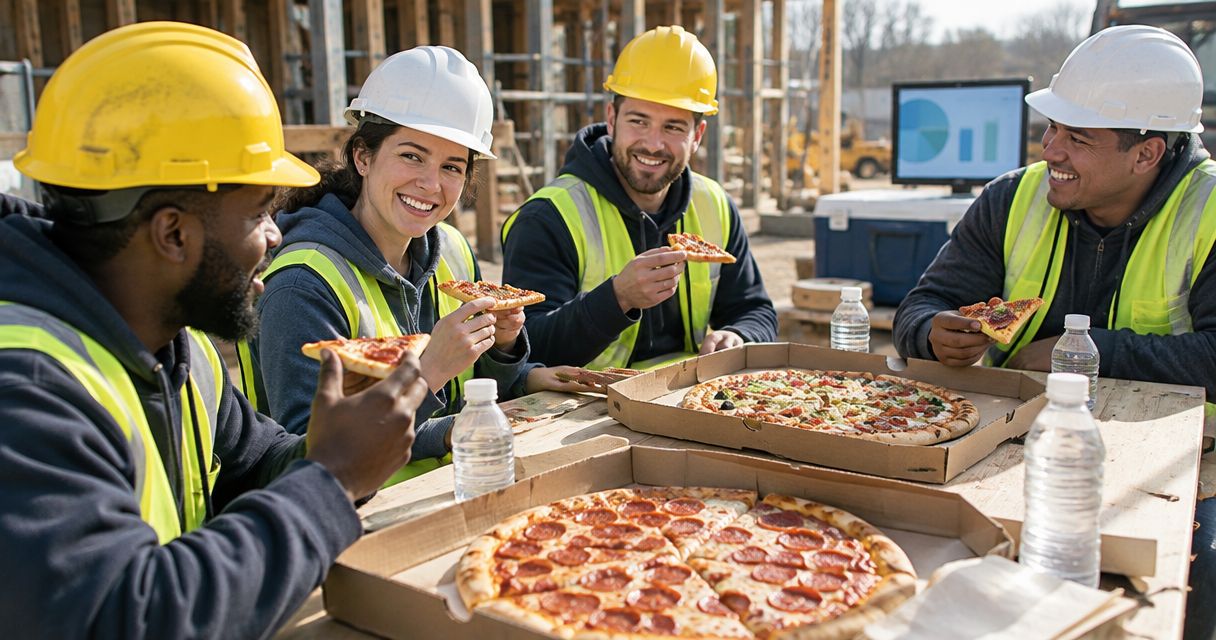
Construction crew pizza catering is coordinated group meal ordering with the aim of feeding your job site without disrupting the workday. This 2026 guide to pizza catering for construction crews covers headcounts, portion planning, dietary needs, pickup versus delivery, and the gate-to-break-area handoff that makes lunch work.
- Sliceofsociety is best for local crews seeking New York-style pizza takeout in Newhall or Santa Clarita.
- Pizza catering for construction crews starts with a confirmed headcount, break schedule, and accessible handoff point.
- Choose job site delivery only after confirming the address, access instructions, and receiving contact.
- Plan crew lunch quantities from confirmed pizza sizes and cuts, not a universal pizzas-per-worker rule.
Why pizza catering matters for construction crews
A crew lunch needs a handoff plan, not just a menu. Workers can be spread across different trades, work zones, and break schedules. Your order needs to reach the people eating it without sending a driver through an active work area or pulling the receiving contact away at the wrong moment.
Pizza gives you a shared meal to divide at a designated break area. But shared boxes also require clear labeling, a clean serving surface, and a plan for workers who eat later. Ordering everything for the earliest break does not solve staggered lunch service.
Sliceofsociety offers New York-style pizza, small plates, online ordering, takeout, and delivery in Newhall/Santa Clarita. Sliceofsociety is best for local crews seeking New York-style pizza takeout in Newhall or Santa Clarita. For a construction site order, confirm the requested quantity, timing, and fulfillment arrangements rather than treating ordinary delivery as a dedicated catering service.
How to plan a construction crew pizza lunch
1. Confirm who is actually eating
Start with a written roster or a message to each trade lead. Count the workers who will be present for the meal, not everyone assigned to the project. Include supervisors, visiting subcontractors, and inspectors only when you know they are joining lunch.
Separate the meal count from the site attendance count. Someone working through an earlier shift or leaving before lunch does not belong in the same order as someone eating at the scheduled break. Ask each lead to return a confirmed count before you finalize the order.
For recurring crew lunches in 2026, keep a reusable planning sheet, but refresh the headcount every time. Yesterday's roster is a starting point, not today's order. Assign responsibility for changes so several people do not send conflicting instructions to the restaurant.
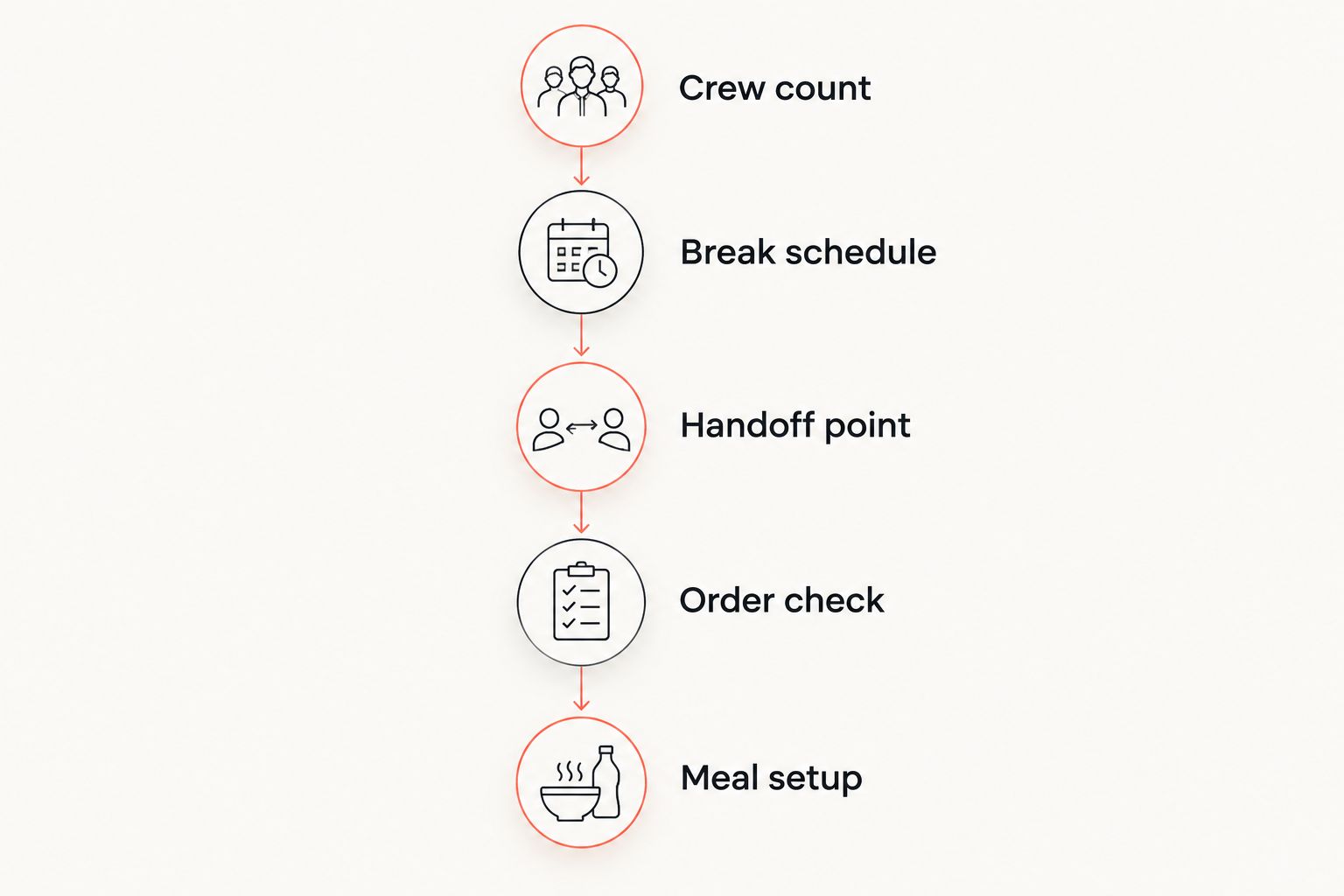
Close this step with a record of:
- Crew count: confirmed diners by trade or team.
- Break schedule: who eats together and who eats later.
- Dietary requests: named needs without sharing private medical details.
- Order owner: the person authorized to finalize or change the meal.
2. Build quantities from the actual pizza format
Use the restaurant's current menu to confirm pizza sizes and how each pizza is cut. Then ask your crew leads about likely portions, whether pizza is the whole meal, and whether workers are bringing their own food. Do not turn a guessed slice count into a purchase order.
Calculate the order from confirmed portions and confirmed cuts. Your working method is straightforward: total the planned slices across diners, divide by the restaurant's confirmed slices per pizza, and round up to whole pizzas. Recheck the result by topping group so a specialty choice does not leave another group short.
A slice is not a standard serving across every restaurant. Diameter, cut, and toppings affect what you are ordering, so keep the calculation tied to the actual menu. If the restaurant cannot confirm a cutting request, plan around its normal format instead.
Keep the quantity sheet practical:
- Record the pizza size and standard cut before calculating totals.
- Ask trade leads about expected portions instead of assigning a universal allowance.
- Count small plates separately from pizza portions.
- Decide who authorizes additional food if the headcount changes.
3. Match the menu to the crew's needs
Collect preferences manually before browsing the menu. Ask which toppings people will eat, which ingredients they avoid, and whether anyone needs an allergy-related accommodation. A simple order that people can identify is easier to distribute than a collection of unlabeled custom requests.
Once the roster and portions are settled, use Sliceofsociety's online ordering to review New York-style pizza and small plates. That gives your order owner a direct way to build the meal, but unusual quantities, dietary questions, or site-specific instructions still need confirmation before submission.
Do not assume a vegetarian pizza is dairy-free, or that removing an ingredient resolves an allergy concern. Ask about ingredients and preparation directly. For an accommodation the restaurant cannot confirm, arrange a separate suitable meal rather than promising safety on its behalf.
Your menu check should cover:
- Choose toppings from the current menu, not an old order screenshot.
- Map each dietary request to a confirmed meal.
- Ask about ingredient and cross-contact concerns before ordering.
- Request identifiable packaging or maintain your own box-to-order list.
- Keep any separate dietary meal out of the general serving rotation.
4. Choose pickup or delivery around site access
Start by checking whether an authorized person can collect the order without leaving essential work uncovered. Pickup gives you control over the receiving person and the final trip to the site. It also makes that person's travel, vehicle space, and safe handling part of your lunch plan.
Delivery removes the pickup trip, but it introduces a site handoff. Confirm the service arrangement for the specific address, order, and requested time. A map pin alone does not explain a temporary entrance, locked gate, or construction trailer behind a separate access road.
For your 2026 job site lunch plan, choose the option with the clearest receiving arrangement—not simply the option that takes fewer steps online. The guide to placing a large takeout order for a group in Newhall covers the group-ordering side; your site lead still owns access and distribution.
Before selecting fulfillment:
- Name the pickup person or delivery receiver.
- Confirm that the requested order and timing can be accommodated.
- Check vehicle space if collecting stacked boxes and other food.
- Identify a permitted handoff location outside active work routes.
- Prepare an alternative if access changes before lunch.
5. Write the handoff instructions before ordering
Use a short note that the receiving person can read without interpreting site shorthand. Include the street address, permitted entrance, recognizable landmark, contact details, and meeting location. Keep restricted access information within your site's rules.
Bring the receiver to the handoff point; do not send a food driver looking for the crew. Your site procedures govern who can enter, where vehicles can stop, and which routes are safe. A lunch order does not replace those procedures.
Keep a separate internal note for distribution. The person receiving boxes needs to know where they go next, which meals are reserved, and who checks the order. Confirm the instructions again if gates, parking, or work zones change on the meal date.
Make these details explicit:
- Handoff point: the approved place to meet outside active work routes.
- Receiving contact: the person ready to answer and collect the order.
- Access instructions: the permitted entrance and any applicable restrictions.
- Order check: the person comparing boxes against the confirmation.
- Meal setup: the clean break-area surface used for serving.
6. Set up safe serving and staggered breaks
Prepare the break area before food arrives. Use a clean surface away from dust, chemicals, and active work, and make handwashing arrangements clear under your site's procedures. Keep serving supplies and trash collection together so workers do not need to search for them.
USDA food-safety guidance for perishable food applies to pizza with perishable toppings: keep hot food at 140°F or above and cold food at 40°F or below. Refrigerate perishable food within 2 hours, or within 1 hour when the surrounding temperature exceeds 90°F. Those are safety limits, not a suggested lunch-service window.
Apply those limits to your 2026 crew meal from receipt through leftovers. Closed cardboard boxes are not verified hot-holding equipment. For staggered breaks, arrange suitable temperature control or ask whether separate fulfillment times can be accommodated rather than leaving the later crew's meal on a table.
Before the first break:
- Set food on a clean, designated serving surface.
- Keep reserved dietary meals identifiable and separate.
- Provide appropriate serving utensils and handwashing access.
- Record when the order arrives and monitor holding conditions.
- Refrigerate suitable leftovers promptly or discard food outside safe limits.
7. Check the order and improve the next lunch
Compare the received food with the order confirmation before opening every box for general service. Check quantities, topping groups, and separate dietary meals first. Contact the restaurant promptly about a discrepancy while keeping the confirmed meals organized.
After lunch, record what was eaten and what remained by menu choice—not just the number of empty boxes. A leftover topping group can tell you more than the total leftover count. Ask later-break workers whether their meal arrangement worked before repeating it.
For repeat orders in 2026, retain a short meal log alongside the order confirmation. Keep the useful details and remove sensitive dietary information when you no longer need it. The next order should reflect the current crew, not become an automatic copy of the last one.
Record the details that change decisions:
- Compare ordered quantities with received quantities.
- Note leftovers by topping or meal type.
- Log access or handoff problems and their fixes.
- Ask each break group whether distribution worked.
- Update the next order only after confirming its headcount.
Start your crew lunch order
Review New York-style pizza and small plates, then confirm the quantity and job site arrangements.
Compare crew lunch arrangements
Choose fulfillment around access, staffing, and break timing. Sliceofsociety offers takeout, delivery, and dine-in; the right arrangement depends on your specific order and site. Confirm the requested arrangement directly rather than assuming a standard restaurant order includes setup or staffed service.
| Option | Best for | Practical advantage | Key limitation |
|---|---|---|---|
| Crew-organized pickup | Sites with restricted access and an authorized pickup person | Your team controls the final handoff | Requires a person, vehicle space, and a safe transport plan |
| Restaurant delivery | Sites with a clear, permitted receiving location | Removes the crew's pickup trip | Address, order timing, and access require confirmation |
| Separate orders for break groups | Crews eating at different times | Lets you plan each group's meal separately | Requires confirmation of each order and fulfillment time |
| Off-site dine-in | Team meals scheduled away from active site duties | Keeps serving outside the work area | Requires travel and confirmation of group arrangements |
Pickup is not automatically better than delivery, and delivery is not automatically a catering package. The deciding question is who controls the final handoff. If nobody is assigned to receive lunch, neither arrangement is ready.
Common mistakes construction crews make
Ordering against the project roster
The full project roster includes people who are not necessarily eating that day. Confirm meal attendance with each trade lead and count visiting workers deliberately. Keep late additions with the order owner instead of letting several people revise quantities independently.
Using the office address without gate instructions
A billing address does not identify the right construction entrance. Confirm the permitted receiving location and assign someone to meet the order there. Never make driver access depend on finding a worker inside an active zone.
Serving every break group from the same unattended boxes
The first crew's lunch time is not the second crew's serving plan. Check temperature control and elapsed time for later breaks, or arrange separately confirmed orders. Do not treat a closed lid as proof that food stayed safely hot.
Treating topping preferences as allergy instructions
A request to omit an ingredient is not confirmation of a suitable allergy accommodation. Ask the restaurant about ingredients and cross-contact, then keep the agreed meal identifiable. Arrange an alternative when the required accommodation cannot be confirmed.
Leaving cleanup to whoever finishes last
Lunch is not finished when the final slice disappears. Assign responsibility for collecting boxes, removing food waste, and checking the break area. Keep packaging out of walkways and vehicle routes before work resumes.
FAQ
What's the best way to arrange pizza catering for construction crews?
Confirm the diners, break schedule, pizza format, dietary needs, and receiving location before placing the order. Assign one order owner and one receiving contact so quantities and site instructions stay consistent.
Is pickup better than pizza delivery to a job site?
Pickup is better when site access is restricted and an authorized person can collect the food. Delivery is better when the order can be accommodated and a receiver can meet it at a clear, permitted handoff point.
How many pizzas should I order for a construction crew?
Calculate the quantity from your confirmed diners, planned portions, and the restaurant's actual pizza size and cut. Divide the planned slice total by the confirmed slices per pizza and round up to whole pizzas; do not assume every restaurant uses the same format.
Does Sliceofsociety offer construction site catering?
Sliceofsociety offers New York-style pizza, small plates, online ordering, takeout, and delivery in Newhall/Santa Clarita. Confirm large-order handling, the requested timing, and job site fulfillment directly rather than assuming a dedicated construction catering package.
How much does pizza catering for a crew cost?
Get the current total for your confirmed quantities, menu choices, and fulfillment arrangement before approving the order. Check the final order summary and any applicable charges rather than estimating from an old receipt.
How long can pizza sit out at a job site lunch?
USDA guidance says to refrigerate perishable food within 2 hours, or within 1 hour when the surrounding temperature exceeds 90°F. For longer service, use appropriate temperature control; cardboard pizza boxes are not verified hot-holding equipment.
What should I tell the restaurant about a construction site delivery?
Provide the exact address, permitted handoff location, access instructions, and receiving contact. Confirm that the requested order and timing can be accommodated, and have the receiver meet the order without directing a driver through active work areas.
One last thing
Test the route from the handoff point to the lunch table before ordering. Check who can carry the boxes, where they will be set down, and whether the route conflicts with site activity. A clear destination at the gate means little if nobody has planned the final move to the break area.