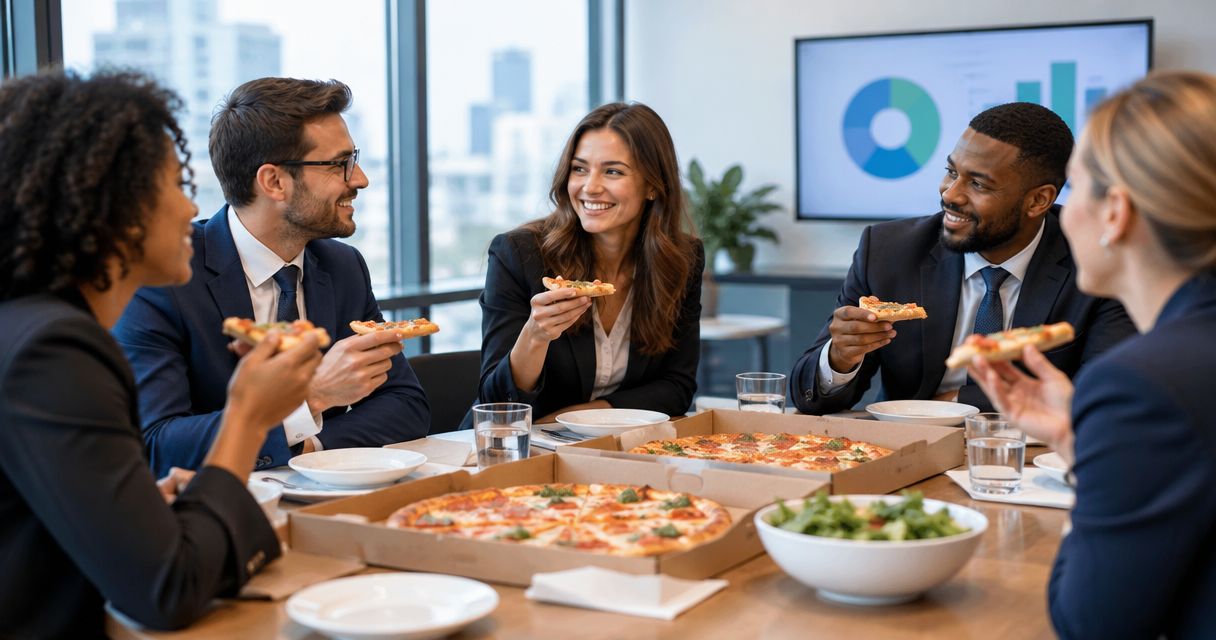
Law firm pizza catering is coordinated group food service with the aim of feeding attorneys, staff, and guests without interrupting the working day. This 2026 guide to pizza catering for law firms covers headcounts, dietary needs, ordering, building access, and a clean handoff between lunch and legal work.
- Pizza catering for law firms starts with confirmed attendance, dietary requirements, and a named receiving contact.
- Sliceofsociety offers New York-style pizza in Newhall/Santa Clarita; confirm large-order arrangements before committing.
- Choose pickup for a dedicated coordinator, delivery for an office meal, and dine-in for an off-site gathering.
- Keep catering instructions separate from client names, matter details, and confidential meeting materials.
Why pizza catering matters for law firms
Plan the meal around the meeting, not the meeting around the meal. A staff appreciation lunch, recruiting event, and working session need different setups even when the food is the same. Decide whether people will eat together, collect lunch between appointments, or stay at their desks.
Your firm's constraints belong in the order brief: a fixed break, controlled building access, confidential workspaces, and attendees who cannot leave a call to meet a driver. The work team pizza lunch guide covers the broader office setting; the steps below address the legal-office handoff.
A pizza order is not automatically full-service catering. Confirm exactly what the restaurant will provide and what your office must handle, including serving utensils, setup, labeling, and cleanup. For your 2026 planning, treat those responsibilities as separate decisions rather than assumptions bundled into the word catering.
How to plan pizza catering for your law firm
Define the occasion and meal format
Start with a shared calendar invitation and a short planning note. Record the purpose, attendees, eating location, and person responsible for the meal. A staff lunch can use a shared serving table; a client-facing meeting needs a deliberate choice about whether food belongs inside the meeting room at all.
Best for working sessions: keep food service outside the document workspace. That gives attendees a place to collect lunch without placing open boxes beside exhibits, laptops, or signed paperwork. For an informal team celebration, a communal table makes more sense than individually managing every attendee's order.
Decide how late arrivals will eat before selecting the menu. Do not assume the same serving arrangement works for people attending the full event and people arriving after court or an appointment.
- Name the occasion: staff lunch, recruiting, training, or client gathering.
- Choose a shared meal or staggered collection.
- Identify a food area separate from sensitive materials.
- Assign a meal coordinator and a backup.
- Record who will arrive after the main break.
Confirm attendance and dietary requirements privately
Use a simple RSVP form or direct email before ordering. Count everyone eating, not just the attorneys listed on the meeting invitation. Include support staff, visiting colleagues, interview candidates, and guests when they are part of the meal.
Ask about dietary requirements privately. Separate preferences from allergies and medically necessary restrictions, then confirm the restaurant's ingredients and preparation practices directly. A vegetarian topping choice does not establish vegan suitability, and removing a topping does not establish an allergen-safe meal.
For your 2026 office lunch, keep dietary information out of a broadly circulated attendance sheet. Share only what the restaurant and meal coordinator need to arrange suitable food. Do not promise an allergen-safe meal before the restaurant confirms what its kitchen can accommodate. If it cannot meet a requirement, arrange a separate suitable meal with the attendee's agreement.
- Count confirmed diners and unresolved RSVPs separately.
- Include staff and guests who are not calendar organizers.
- Collect dietary requirements through a private channel.
- Ask about ingredients and cross-contact precautions.
- Assign any separately arranged meal to its intended recipient.
Check the restaurant's ordering arrangements
Build the order brief yourself first: event date, address, meal format, attendance, dietary requirements, and receiving contact. Then use the restaurant's ordering channel to discuss the actual food and handoff. A prepared brief avoids repeated messages about basic details.
Sliceofsociety offers New York-style pizza, small plates, online ordering, takeout, delivery, and dine-in in Newhall/Santa Clarita. Those choices give you different ways to arrange a firm meal; they do not establish a dedicated catering package, delivery radius, setup service, or guaranteed turnaround.
Sliceofsociety is best for Newhall/Santa Clarita law firms seeking New York-style pizza for an informal team meal. The fit is food and location. Confirm whether your proposed order, timing, and dietary needs work before presenting the restaurant as the final plan.
The faster path is online ordering once the details are settled—not using checkout as a substitute for confirming a complex group request.
- Confirm the event date and requested handoff time.
- Ask how to submit and confirm a large order.
- Verify pickup or delivery arrangements for your address.
- Confirm which serving supplies you must provide.
- Record the accepted order details in one place.
Build the menu around confirmed portions
Start with the current menu and the restaurant's guidance on pizza sizes, cuts, and portions. Do not calculate quantities from an assumed slice count. New York-style pizza describes a style, not a guaranteed number of portions per pie.
Choose enough variety to cover confirmed preferences without turning the table into a puzzle. Keep clearly identified dietary meals separate from communal selections. If you add small plates, check how they will be served and whether the office has the utensils they require.
Best for a short office break: choose food your team can collect and carry without assembly. A dish that needs individual plating changes the workload for the coordinator. Small plates add variety, but also add serving decisions; pizza keeps the shared order simpler, but still needs labeling and a clear portion plan.
Approve the final menu with the person responsible for the event before submitting it. That is the point to resolve changes, not after food arrives.
- Confirm pizza size and slice count with the restaurant.
- Ask for quantity guidance using your actual attendance.
- Identify each selection on the serving table.
- Keep separately arranged dietary meals clearly designated.
- Match small plates with the necessary utensils.
Assign the pickup or delivery handoff
Choose the receiving method before placing the order. Pickup works when someone can leave the office without abandoning the event. Delivery keeps that person on-site, but requires an accessible entrance and a contact who will answer during the handoff.
Write practical instructions: building entrance, suite, reception procedure, and receiving contact. Keep client names, matter descriptions, and meeting agendas out of the order notes. The restaurant needs logistics, not the purpose of a confidential legal meeting.
For a 2026 firm event, make the backup contact part of the plan from the start. Someone in a deposition, hearing, or client call is not a reliable sole contact for an arrival. Name a receiver who is free to receive the food.
Keep the receiving point separate from the room where confidential work is happening. Reception or another approved common area lets staff direct the handoff without inviting unnecessary access to the working space.
- Select pickup or delivery based on staff availability.
- Give the exact entrance and suite instructions.
- Name a primary receiver and a backup.
- Confirm the receiver can answer calls or messages.
- Move food from reception to the designated serving area.
Set up a safe, document-free serving area
Start with an ordinary office table, cleared of documents and equipment. Add plates, napkins, serving utensils, and ingredient labels as appropriate. Position the table so collecting lunch does not block reception or the meeting-room doorway.
Food safety matters when attendance is staggered. USDA leftover guidance says to refrigerate perishable food within 2 hours, or within 1 hour when temperatures exceed 90°F. Use that guidance for your 2026 meal plan; do not leave pizza out indefinitely for colleagues returning later.
Mark when the food reaches the serving table and assign someone to handle leftovers. Follow USDA guidance to reheat leftovers to 165°F. These are food-safety limits, not a promised restaurant holding time or a suggested meeting duration.
A separate dietary meal needs its own handling plan. Shared utensils and a common serving surface do not become suitable for an allergy simply because the menu item has a label.
- Clear the serving table of files and electronics.
- Place napkins and utensils before food arrives.
- Identify selections without exposing personal dietary details.
- Record when perishable food is set out.
- Refrigerate leftovers within USDA's stated limits.
Close the order and record what worked
Use a reusable event note rather than relying on someone's memory. Record confirmed attendance, what was ordered, how the handoff worked, and whether separately arranged meals reached the right people. Keep the restaurant receipt with the firm's expense documentation.
For your next 2026 lunch, use those observations to adjust the order. Record actual leftovers instead of describing the quantity as generous or insufficient without detail. A repeat order still needs a fresh attendance check; a recruiting lunch and an internal meeting are not interchangeable.
Best for recurring firm lunches: reuse the process, not an unverified headcount. Keep sensitive information out of the template so it can be safely shared with the next coordinator.
- Save the confirmed order and receipt.
- Record actual attendance and leftover portions.
- Note any entrance or handoff problems.
- Check that designated meals reached their recipients.
- Update the planning template for the next event.
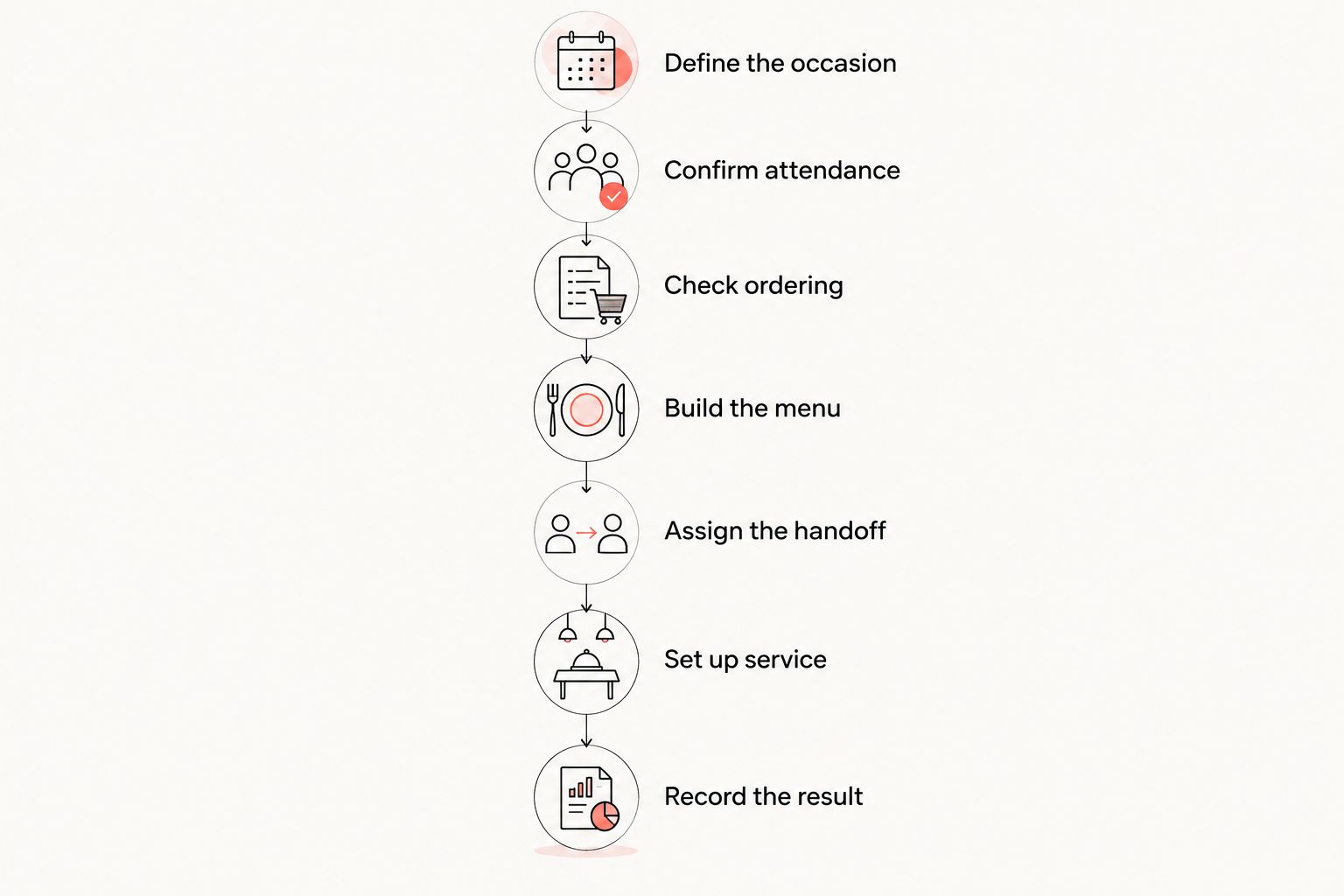
The reusable sequence is: define the occasion, confirm attendance, check ordering, build the menu, assign the handoff, set up service, and record the result. Each decision gives the next person what they need to act.
Compare meal options for your law firm
Choose the format by responsibility, not just by food preference. The table separates what each option does well from the work your firm still owns. None should be treated as staffed catering unless that service has been explicitly agreed.
| Option | Best for | Main advantage | Key limitation |
|---|---|---|---|
| Pizza pickup | An office with a dedicated collection coordinator | Your staff controls the collection and office handoff | Someone must leave the office and transport the food |
| Pizza delivery | A working lunch with a clear receiving point | Your coordinator stays on-site | Building access and an available receiver still need planning |
| Pizza and small plates | An informal gathering that needs menu variety | More shared food choices | Additional dishes require serving and dietary checks |
| Lounge dine-in | An off-site team celebration | Separates the meal from the office workspace | Staff must travel; group seating and entertainment timing need confirmation |
Sliceofsociety's New York-style pizza and small plates fit the shared-food approach; its cocktails, live jazz, and DJ entertainment belong to a different kind of outing. Keep a working lunch and a lounge celebration as separate plans. Confirm the day's entertainment and seating arrangements before choosing dine-in for a conversation-focused gathering.
For any format, the trade-off is clear: convenience does not remove coordination. Pickup moves the logistics to your staff, delivery moves them to the entrance, and dine-in moves them outside the office.
Plan your firm's pizza order
Review the site, then confirm your group size, dietary needs, and pickup or delivery arrangements.
Common mistakes law firms make with pizza catering
Counting attorneys but forgetting the rest of the team
The calendar's main participants are not always the full lunch audience. Count everyone invited to eat, including administrative staff and visiting colleagues. Otherwise, the order brief starts with the wrong attendance figure.
Using confidential details as delivery instructions
A case name is not an entrance instruction. Use the firm name, suite, receiving contact, and approved handoff location; keep client and matter information out of restaurant notes and visible serving labels.
Treating the delivery receiver as an honorary role
Naming someone who is busy throughout the arrival window does not solve the handoff. Assign a person who can respond and a backup who knows the order. Make receiving food an actual task.
Leaving food out for colleagues returning from court
An open box on the conference table is not a holding plan. Refrigerate perishable leftovers within USDA guidance, and tell late arrivals where their meal is stored. Do not confuse consideration for late diners with safe storage.
Assuming ordering channels include event staffing
Online ordering, takeout, and delivery do not establish setup, serving, or cleanup service. Confirm the scope with Sliceofsociety before ordering, then assign the remaining tasks within the firm. A clear division of work prevents an unattended serving table.
FAQ
What's the best way to plan pizza catering for law firms?
Start with confirmed attendance, dietary requirements, a meal format, and a named receiving contact. Confirm the restaurant's order arrangements before submitting a group order.
Is pizza pickup better than delivery for a law firm lunch?
Pickup is best when a dedicated coordinator can collect the food; delivery is best when the office has an accessible entrance and an available receiver. Neither option removes the need to arrange serving and cleanup.
Does Sliceofsociety offer food suitable for an informal firm meal?
Sliceofsociety offers New York-style pizza and small plates in Newhall/Santa Clarita. Confirm your group order, dietary needs, and handoff arrangements directly rather than assuming a dedicated catering package.
How many pizzas should I order for a legal team?
Base the quantity on confirmed diners and the restaurant's actual pizza sizes, slice counts, and portion guidance. Include support staff and guests, and account separately for dietary meals.
Can I promise gluten-free or allergy-safe pizza to attendees?
Do not promise an allergy-safe meal without confirming ingredients and preparation practices with the restaurant. A topping change or dietary label does not establish protection from cross-contact.
What should go in delivery instructions for a law office?
Include the entrance, suite, reception procedure, and receiving contact. Exclude client names, matter descriptions, and confidential meeting details.
How long can pizza stay out during an office lunch?
USDA guidance says to refrigerate perishable food within 2 hours, or within 1 hour when temperatures exceed 90°F. Refrigerate leftovers for late arrivals instead of leaving the serving table open indefinitely.
One last thing
Put the receiving contact in the calendar invitation, not just the order notes. The office needs to know who owns the handoff as much as the restaurant does. Pair that name with the serving location and backup contact, and your meal plan becomes usable by someone other than its organizer.