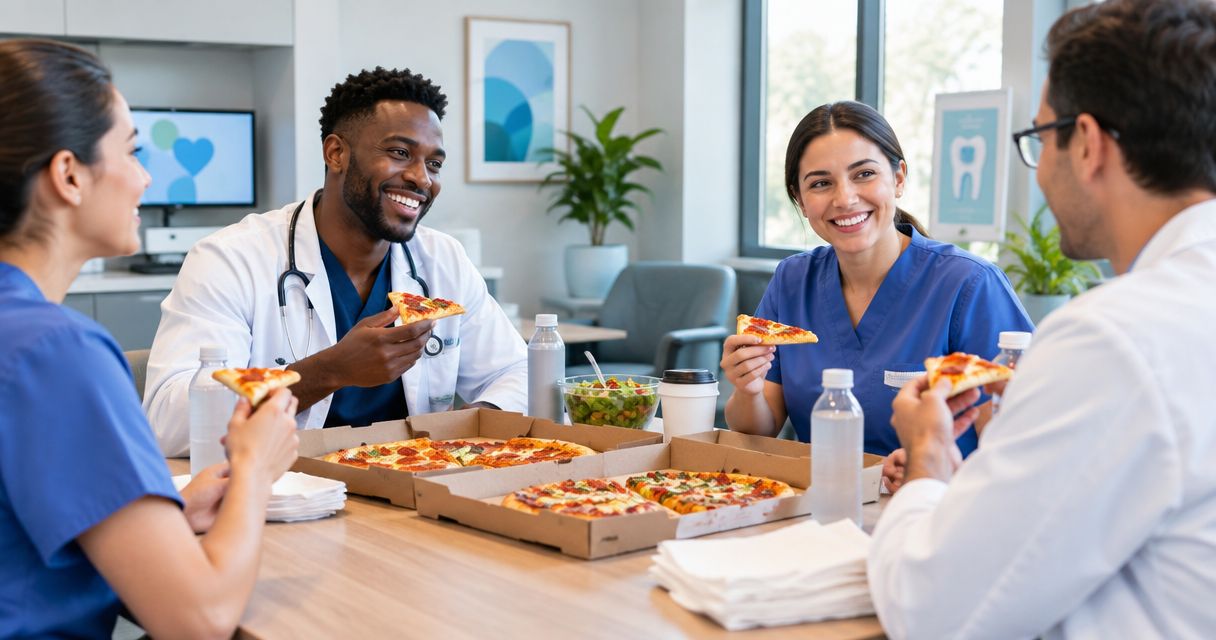
Medical office pizza catering is a coordinated staff meal designed to feed your team without disrupting patient care. This 2026 guide covers medical and dental office lunches, where staggered breaks, dietary needs, and a clear delivery handoff matter as much as the pizza.
- Pizza catering for medical offices starts with confirmed headcounts, break windows, and dietary requirements—not a guess at pizza quantities.
- Sliceofsociety is best for Newhall and Santa Clarita teams seeking New York-style pizza for takeout or delivery.
- Dental office lunches need coverage plans so reception, assistants, and clinicians can all take a break.
- Confirm large-order logistics directly; ordinary delivery does not establish staffed catering or special dietary preparation.
Why pizza catering matters for medical and dental offices
An office lunch succeeds when the last staff member gets a meal, not just when the first pizza box opens. Reception cannot necessarily stop answering calls when clinicians start eating, and a dental assistant finishing a procedure needs a plan that does not depend on everyone arriving together.
Pizza lets you organize a shared meal without arranging individual entrees for every employee. The trade-off is shared handling: you need labeled boxes, separate serving utensils, and a plan for staff whose dietary requirements do not fit the order.
Sliceofsociety offers New York-style pizza, small plates, takeout, and delivery in Newhall/Santa Clarita. It is a local pizza option, not a reason to assume catering packages, allergy-safe preparation, or a particular delivery arrangement. Confirm those details before committing your office lunch.
Plan the lunch around the practice
1. Define the meal and assign an owner
Start with a shared note or spreadsheet. Write down whether you are feeding a regular lunch, welcoming a new employee, thanking the team, or supporting a training session; each purpose changes who needs to attend and whether everyone must eat together.
Name an organizer with authority to finalize the order. Separate the purchasing decision from the receiving task if the organizer will be treating patients when the food arrives.
For your 2026 lunch plan, distinguish staff appreciation from a sponsored presentation. If an outside organization is paying, get the practice's approval before sharing an invitation or submitting an order; food arrangements do not replace your internal approval process.
- State the occasion and who is included.
- Assign an order owner and a receiving contact.
- Confirm who approves the purchase.
- Decide whether attendance is shared or staggered.
- Keep patient information out of ordering notes.
2. Count people by break window
Use the staff schedule, then ask employees to confirm that they will eat. Count the people working that day rather than the full practice roster, and include temporary staff or visiting team members only after checking with the manager.
Separate headcount from break timing. A single confirmed total helps with quantities, but it does not tell you whether food must serve one group or several groups over the afternoon.
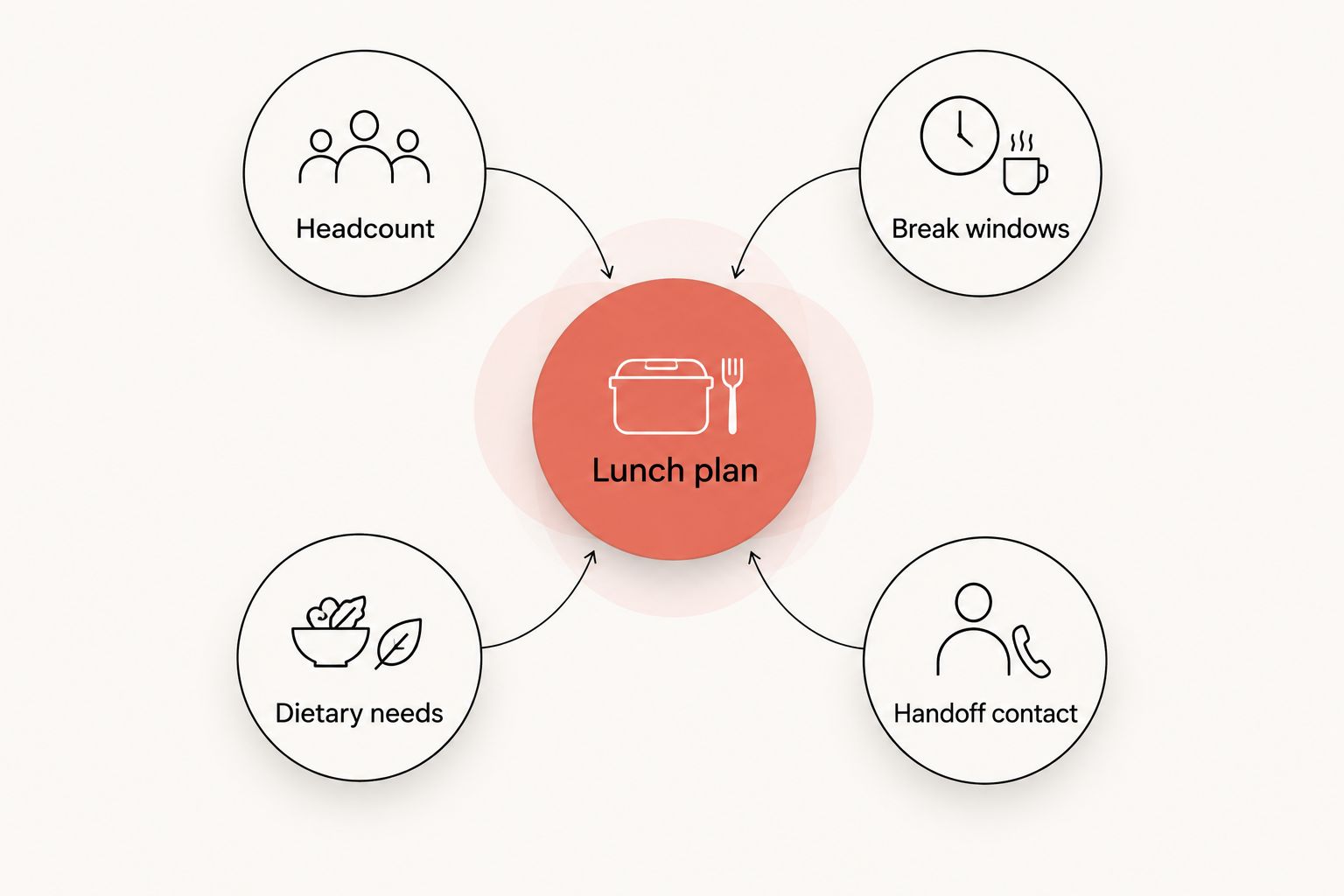
Record four planning fields: Headcount, Break windows, Dietary needs, and Handoff contact. Those fields give the organizer a usable brief without turning lunch into another administrative project.
A dental office can use this same method for reception, hygienists, assistants, and dentists. Do not assume a gap in the appointment book gives every role a break at the same time.
- Confirm attendance with each department or work group.
- Record the earliest and latest eating windows.
- Include staff covering reception during the first break.
- Collect dietary requirements privately.
- Update the count when staffing changes.
3. Confirm the menu before calculating quantities
Check the current menu manually and ask the restaurant about pizza sizes, cutting patterns, ingredients, and large-order handling. Calculate the order from confirmed serving information, not from a universal pizzas-per-person rule. Slice sizes and appetites are not interchangeable.
For a local starting point, Sliceofsociety offers New York-style pizza and small plates. Its online ordering is the direct route for reviewing the order choices; contact the restaurant about requirements that the ordering process does not clearly address.
Use the guide to placing a large takeout order in Newhall when coordinating a group purchase. A large takeout order still needs confirmation—it does not establish delivery timing, serving equipment, or staffed service.
Ask about dietary requirements before choosing toppings. A vegetable topping does not make a pizza vegan, and removing an ingredient does not establish protection from allergen cross-contact.
- Confirm the actual pizza size and number of slices.
- Ask staff whether pizza is their full meal or a snack.
- Check ingredients for each requested dietary restriction.
- Ask about shared equipment and preparation surfaces.
- Arrange a separate suitable meal when requirements cannot be met.
4. Choose pickup or delivery around patient coverage
Compare the two methods against your staffing plan. Pickup gives your designated runner responsibility for transport; delivery keeps that person in the office but requires a reachable recipient and clear access instructions.
For your 2026 order, confirm the arrangement at checkout or directly with the restaurant. Do not infer delivery coverage, order capacity, or a promised arrival time from the fact that delivery is offered.
Sliceofsociety offers both takeout and delivery. The right choice depends on whether your practice can spare a runner and whether your building has a straightforward handoff point—not on which method sounds more convenient.
Send building information rather than patient details. Include the suite, permitted entrance, and receiving contact, then make sure that contact can answer without abandoning a clinical task.
- Check whether a runner can leave without reducing coverage.
- Confirm the requested fulfillment time before scheduling lunch.
- Identify a permitted entrance and suite location.
- Give the receiving contact the final order details.
- Plan who takes over if that contact becomes unavailable.
5. Set up a clean staff-only serving area
Prepare the break room before the food arrives. Use a clear table away from clinical work, leave room for people to move through, and keep food away from instruments, specimens, treatment surfaces, and patient paperwork.
Arrange the boxes so people can identify their choices without opening every lid. Label confirmed ingredients accurately; do not write allergy-free, gluten-free, or vegan unless the restaurant has specifically confirmed the relevant preparation and ingredients.
Keep alcohol out of the clinical workday meal. A restaurant's lounge identity does not need to shape an on-duty lunch; pizza and a practical serving setup are the point here.
Place a waste bin where people can clear plates without blocking the next person. If your break room is small, release staff in groups rather than creating a queue that spills into patient areas.
- Clear and clean the serving surface.
- Supply plates, napkins, and appropriate serving utensils.
- Label the boxes using confirmed order information.
- Keep separate meals separate from shared utensils.
- Position trash and recycling outside the serving queue.
6. Protect food across staggered breaks
Build food safety into the schedule instead of treating leftovers as an afterthought. Assign someone to track when food arrives and when it should be refrigerated or discarded.
For 2026 office lunches, USDA consumer food-safety guidance sets a 2-hour limit for perishable food at room temperature, reduced to 1 hour when temperatures exceed 90°F. USDA also advises keeping cold food at 40°F or below and hot food at 140°F or above; these are food-handling limits, not restaurant delivery promises.
Do not treat a cardboard pizza box as hot-holding equipment. If later breaks extend beyond safe handling limits, promptly refrigerate the later group's portions and follow safe reheating practices rather than leaving the entire order on the table.
Your clinical schedule is not a reason to stretch the food-safety window. If the practice cannot safely store or hold the meal, change the timing or arrangement before ordering.
- Record the arrival time with the receiving contact.
- Check that the break-room refrigerator has space.
- Set aside later portions before the first group serves itself.
- Use appropriate equipment for any temperature-controlled holding.
- Discard food that exceeds safe handling limits.
7. Close the lunch and improve the next order
Use a short staff check-in rather than a lengthy survey. Ask whether people received enough food, whether their dietary needs were addressed, and whether they could eat during their assigned break.
Record what was ordered and what remained. Separate unopened or safely handled leftovers from food that sat out too long; an empty table alone does not tell you whether the quantity was right.
For the next 2026 lunch, reuse the useful details, not the entire order unchanged. Attendance, staff preferences, and appointment coverage can differ even when you order from the same restaurant.
A successful lunch should reduce the organizer's work next time. Keep one reusable planning note with the handoff instructions and break-room setup, then reconfirm all restaurant-specific details for the new order.
- Save the confirmed headcount and actual attendance.
- Note which choices were eaten and which remained.
- Ask later-break staff whether they received their intended meal.
- Record any handoff or coverage problem.
- Update the planning note before the next lunch.
Compare office lunch options
Best for local New York-style pizza: Sliceofsociety suits Newhall and Santa Clarita teams seeking takeout or delivery. Its stated offering does not establish staffed catering, specialized dietary preparation, or a guaranteed office-lunch schedule.
Compare the meal arrangement as well as the food. A shared pizza order, individual meals, and staffed catering solve different organizational problems; choose the method your practice can receive and serve without interrupting care.
| Option | Best for | Practical advantage | Key limitation |
|---|---|---|---|
| Restaurant pizza pickup | Practices with a designated runner | Your team manages collection and transport | The runner must leave the practice and carry the order |
| Restaurant pizza delivery | Offices that need staff to remain on-site | No employee pickup trip | Requires confirmed delivery logistics and a reachable recipient |
| Individually organized meals | Teams with different dietary needs or break times | Each meal can be assigned to a person | Separate orders and labels require more coordination |
| Staffed catering, if arranged | Events needing serving or setup support | Service duties can be included in the agreement | Requires a separately confirmed scope; ordinary pizza ordering does not imply it |
Do not choose a full-service arrangement just because the lunch is called catering. If your staff can handle receiving, serving, and cleanup, a coordinated restaurant order is the simpler format to assess.
Common mistakes medical and dental offices make
Ordering from the payroll roster
A roster includes people who are off, working elsewhere, or not joining the meal. Use confirmed attendance for that day, including any visiting staff who have been approved to join.
Scheduling everyone for the same break
An all-team invitation is not a coverage plan. Decide who answers calls, handles arrivals, and covers essential duties before announcing the lunch window; include those people in a later serving group.
Treating vegetarian food as allergy-safe
Meat-free toppings do not answer questions about milk, wheat, or preparation surfaces. Ask the restaurant about the actual requirement, and do not promise a colleague a safe meal based on the topping name alone.
Leaving food out for the final appointment block
Later staff deserve a planned meal, not whatever has been sitting in open boxes. Reserve their portions early and arrange safe storage when their break falls outside the room-temperature handling window.
Sending food through the patient workflow
A busy reception desk is not automatically the right delivery destination. Choose a permitted handoff location and receiving contact so food does not compete with patient check-in or enter treatment areas.
FAQ
What's the best way to plan pizza catering for medical offices?
Start with confirmed attendance, dietary requirements, and staff break windows. Then confirm the restaurant's serving information and fulfillment arrangement before calculating quantities.
How many pizzas should I order for a dental office lunch?
Base the quantity on confirmed attendance, the restaurant's actual pizza size and slice count, and whether pizza is the full meal. Ask the restaurant for order guidance rather than using a universal pizzas-per-person formula.
Is pickup or delivery better for a medical office?
Delivery fits offices that need staff to stay on-site; pickup fits offices with a designated runner. Either method needs a confirmed fulfillment time and someone responsible for receiving the food.
Can Sliceofsociety provide pizza for an office lunch?
Sliceofsociety offers New York-style pizza, takeout, and delivery in Newhall/Santa Clarita. Confirm your group order requirements directly, including quantities, timing, and dietary questions.
How do I accommodate food allergies at a staff pizza lunch?
Ask about ingredients and allergen cross-contact before ordering, and arrange a separate suitable meal when a requirement cannot be met. Do not assume a topping change or a separate box establishes allergy-safe preparation.
How long can pizza sit out during staggered staff breaks?
USDA consumer guidance limits perishable food at room temperature to 2 hours, or 1 hour above 90°F. Promptly refrigerate later portions when the break schedule would exceed those limits.
Does a large pizza order include catering staff and setup?
A large pizza order does not establish staffed catering or setup. Confirm any serving equipment, setup, cleanup, and staffing separately before planning around those services.
One last thing
Reserve the later-break portions before opening the lunch to the first group. That small decision makes the meal fairer for the people covering reception or finishing patient care, and gives you a clear point to start safe storage.
For your 2026 practice lunch, build the plan around the colleague who eats last. Everyone else is easier to accommodate.