Senior living pizza catering is coordinated pizza service with the aim of bringing residents together for a meal that fits their community’s dining routines. This 2026 guide to pizza catering for senior living communities puts resident choice, approved diets, accessible service, and a clear food handoff ahead of the order itself.
- Pizza catering for senior living communities starts with resident preferences and approved diets, not a standard slices-per-person rule.
- Sliceofsociety is best for Newhall and Santa Clarita planners seeking New York-style pizza through takeout or delivery.
- Retirement community dining needs a named receiving staff member, an accessible serving plan, and clear ingredient information.
- Confirm large-order arrangements directly; ordinary delivery does not establish staffed catering or medical-diet accommodation.
Why pizza catering matters for senior living communities
A community pizza meal needs to work for residents, dining staff, and visiting families—not just the person placing the order. Independent living, assisted living, and retirement communities have different service routines; individual residents also have different preferences and prescribed diets.
The local starting point is Sliceofsociety, a Newhall/Santa Clarita pizzeria and lounge offering New York-style pizza, small plates, takeout, delivery, and dine-in service. Those offerings give you ordering formats to consider, but they do not establish specialized senior-living catering, dietary substitutions, or on-site serving staff.
Sliceofsociety is best for Newhall and Santa Clarita community planners seeking New York-style pizza through takeout or delivery. For residents with prescribed dietary or swallowing requirements, the community’s dining and clinical teams must approve the meal separately.
That distinction matters. A pizza social is an activity with food; replacing a scheduled community meal also requires coordination with the people responsible for residents’ daily dining. Decide which event you are planning before discussing toppings.
Plan the meal around residents, not pizza boxes
For your 2026 event, create a single order sheet that connects attendance, approved food choices, service format, quantities, and the receiving contact. A shared document or printed worksheet is enough; no paid planning system is necessary.
Use the following steps in order. Keep resident health details inside the community’s approved process, and share only the food requirements the restaurant needs to assess the order.
Confirm attendance
Start with the activity calendar and a simple resident sign-up. Ask whether each person expects to eat the meal, attend without eating, or bring a guest. A headcount for the room is not automatically a headcount for pizza.
Separate residents, visiting family members, and staff who will eat. Then check whether the event overlaps with regular meal service, transportation, or another activity. Approve the attendance list before estimating the order.
Give residents a straightforward way to express preferences without making participation depend on filling out a form. Staff can record verbal responses through the community’s normal process. Avoid treating age as a shortcut for appetite: use resident choices and previous meal records instead.
Assign one person to maintain the final count. If several departments keep separate lists, reconcile them before contacting the restaurant; otherwise, family guests or staff meals can be counted twice.
- Record meal participants separately from event attendees.
- Include guests and staff who will eat.
- Ask residents about topping preferences.
- Identify the person approving the final count.
- Mark when the community will close its sign-up list.
Review diets
Ask the dining manager to review food requirements before you choose pizzas. Use approved resident dining records, not an organizer’s memory. Keep personal medical information out of general activity lists and restaurant messages.
A vegetarian preference, food allergy, prescribed sodium restriction, and texture-modified diet are different requirements. Removing a topping does not establish that a pizza meets any of them. Ingredient information and preparation practices need separate confirmation.
For residents with swallowing difficulties, follow the care team’s prescribed texture requirements. Smaller slices do not make ordinary pizza an approved texture-modified meal. Arrange an appropriate alternative through the community’s dining process when pizza does not fit.
Your 2026 order sheet should distinguish requested preferences from requirements that need approval. If the restaurant cannot confirm a necessary ingredient or preparation detail, do not present the food as suitable. The resident should still have an approved meal and a place at the event.
- Have dining staff review the proposed menu.
- Separate preferences from prescribed requirements.
- Ask for ingredients relevant to documented allergies.
- Confirm preparation practices before making safety assurances.
- Arrange approved alternatives before the event.
Choose service
Start by checking what your own team can handle: pickup transportation, receiving deliveries, setting out food, and assisting residents. The simplest format is the one with a clear owner for every task—not necessarily the one with the fewest ordering steps.
Sliceofsociety offers takeout, delivery, and dine-in service. Those are practical routes for a local pizza meal; confirm the arrangements for your specific group directly. Do not assume a delivery order includes setup, serving utensils, portioning, cleanup, or staff remaining on-site.
Delivery saves the pickup trip, not the community’s receiving and serving work. Pickup gives your team control over collection, but it also puts transport responsibility on your staff. A restaurant outing adds transportation and accessibility questions that an on-site meal avoids.
For a takeout-led event, the guide to placing a large takeout order for a group in Newhall provides a related planning path. Keep senior-living dietary approval and resident assistance in your own event plan.
- Choose pickup, delivery, or a restaurant outing.
- Confirm whether the proposed group order can be accommodated.
- Assign transport or delivery-receiving responsibility.
- List serving supplies your community must provide.
- Verify accessibility before arranging an outing.
Confirm quantities
Build the order from confirmed diners and the restaurant’s actual pizza dimensions and cutting options. Ask for those details rather than assuming every pie produces equivalent portions. A pizza count without portion information is an incomplete order.
Use the community’s previous meal records where available. Record what residents selected, what was served, and what remained; do not substitute a universal slices-per-person rule. Family visitors and staff also need to be included in the calculation.
Choose toppings according to recorded preferences and approved dietary requirements. Give residents meaningful choice without ordering a different pizza for every request. Keep any specially approved portions identifiable through receiving and service.
Ask the restaurant to confirm the final order in writing, including quantities, requested cuts, and any ingredient information discussed. A requested modification is not confirmed until the restaurant accepts it. For your 2026 planning file, retain that confirmation alongside the community’s approved serving plan.
- Confirm pizza dimensions and portion cuts directly.
- Use previous event consumption records when available.
- Count approved alternative meals separately.
- Identify who needs which approved portion.
- Check the written order against the attendance list.
Plan handoff
Name the person who will receive the food and the person who will direct service. They can be the same staff member, but the responsibility must be explicit. Give the restaurant a clear receiving location and a contact through the community’s approved communication process.
Food safety continues after pickup or delivery. USDA consumer guidance for perishable food calls for hot food to stay at 140°F or above and cold food at 40°F or below. It also gives a 2-hour limit outside temperature control, reduced to 1 hour when the temperature is above 90°F. Use these public guidelines in your 2026 plan alongside the community’s applicable food-service procedures.
Do not mistake a closed pizza box for verified hot holding. Have dining staff decide how food will be received, checked, held, served, and handled afterward. If the community serves in stages, account for the entire service period rather than only arrival.
- Specify the receiving entrance and staff contact.
- Check the delivery against the confirmed order.
- Follow community procedures for temperature checks and holding.
- Keep approved special portions identified.
- Record service timing and leftover handling.
Record feedback
Offer assistance without making residents request it in front of the room. Ask privately where practical, and use the community’s usual dining support process. Seat residents before distributing food when that fits the event and their preferences.
A self-service line is not the only option. Staff-assisted plating or table service can avoid requiring every resident to carry a plate, reach across boxes, or stand while choosing food. Match the format to actual participants rather than assuming everyone needs the same help.
Judge the event by whether residents could participate comfortably, not whether every box emptied. Ask what they liked, whether the portions worked, and whether the meal arrived and was served as planned. Record observations without turning private dietary information into general event feedback.
For the next 2026 gathering, change the details that caused friction. Keep preferences that residents endorsed, but repeat the approval process when attendance or dietary requirements change.
- Keep routes clear for residents and mobility aids.
- Offer staff-assisted plating where needed.
- Use readable food labels without exposing medical details.
- Record leftovers by food choice.
- Ask residents which parts of the meal to repeat.
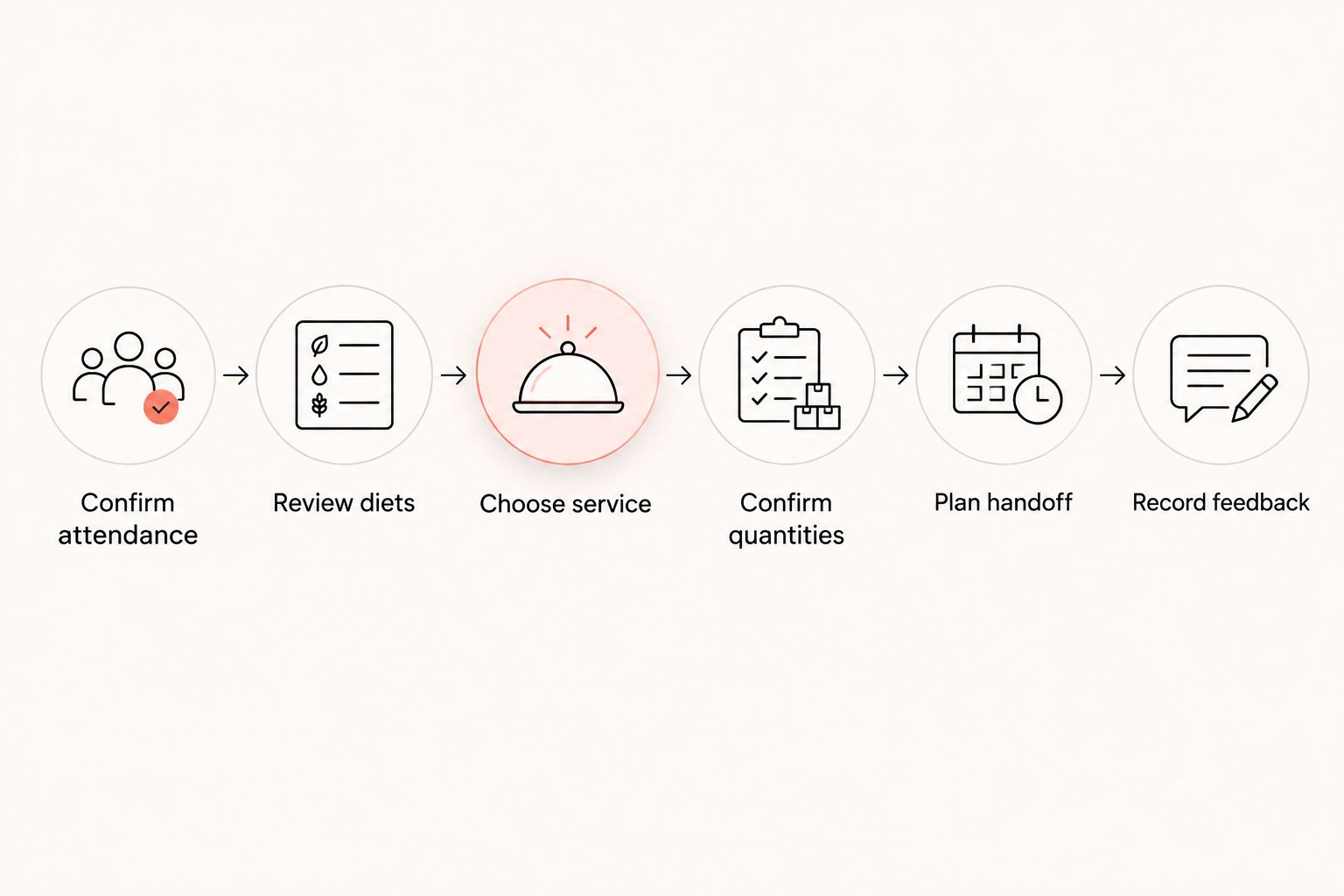
These steps form a repeatable sequence: confirm attendance, review diets, choose service, confirm quantities, plan handoff, and record feedback. Finish the dietary review before committing to the restaurant order.
Compare service options for your community
Choose the service model according to resident needs and available staff. The table compares operational choices, not promises that any restaurant supplies every format. Confirm responsibilities before making the booking or order.
| Option | Best for | Main advantage | Key limitation |
|---|---|---|---|
| Restaurant pickup | Communities with an assigned driver and receiving team | Your team controls collection and transport | Staff handle travel, food transport, and setup |
| Restaurant delivery | On-site meals with a staffed receiving point | Removes the pickup trip | Does not establish setup, serving, or cleanup support |
| Staff-assisted plating | Residents who prefer or require help collecting food | Keeps serving assistance within community routines | Requires staff time and approved handling procedures |
| Self-service buffet | Residents able and willing to serve themselves | Lets diners choose their own portions | Reaching, carrying plates, and standing need assessment |
| Dine-in outing | Residents choosing a restaurant experience | Moves the meal into a restaurant setting | Requires transport, accessibility checks, and group coordination |
Sliceofsociety’s pizza takeout, delivery, and dine-in offerings fit the restaurant-ordering options above. Their limitation for this use case is that the stated offerings do not establish specialized medical-diet preparation or staffed catering. Use a restaurant order for the food and a community-approved plan for resident care and service.
Start with the restaurant
Review the local pizzeria before confirming your community’s group order and service requirements.
Common mistakes senior living planners make
Treating every resident as a light eater
Age does not tell you what someone wants for dinner. Ask residents and consult prior meal records instead of automatically reducing portions. Include family guests and eating staff in the same final count.
Calling an ordinary pizza a modified-diet meal
A thinner crust, smaller cut, or removed topping does not establish compliance with a prescribed diet. Get the appropriate dining or clinical approval, and provide an approved alternative when necessary.
Planning a buffet without checking participation needs
A buffet requires residents to approach the food, make selections, and manage a plate unless staff help. Check those tasks against the people attending. Offer an assisted route without separating residents from the social event.
Assuming the delivery person handles setup
Food arrival and meal service are different responsibilities. Confirm the handoff, then assign community staff to check the order, manage holding, label choices, and serve. Do not leave those tasks to whoever happens to be nearby.
Making pizza the only way to join
A resident who cannot eat the ordered pizza should not have to miss the gathering. Coordinate an approved meal alternative and include that resident in the same seating, conversation, and activity plan.
FAQ
What’s the best way to plan pizza catering for senior living communities?
Start with confirmed attendance and a dining-team review of resident food requirements. Then choose pickup or delivery, confirm portions with the restaurant, and assign receiving and serving staff.
Does Sliceofsociety offer senior living catering?
Sliceofsociety’s stated offerings include New York-style pizza, small plates, takeout, delivery, and dine-in service, not a specialized senior-living catering program. Confirm your proposed group order and any dietary or service requirements directly.
How many pizzas should a retirement community order?
Base the order on confirmed diners, approved meal requirements, actual pizza dimensions, and prior consumption records. Ask the restaurant to confirm portion cuts rather than using an assumed slices-per-person rule.
Can residents with swallowing difficulties eat regular pizza?
Regular pizza must not replace a resident’s prescribed texture-modified meal without care-team approval. Cutting pizza into smaller pieces does not establish that it meets the prescribed texture requirements.
Is pizza delivery better than pickup for a senior community?
Delivery is best when the community wants to avoid a pickup trip and has staff ready to receive the food. Pickup is best when an assigned driver can manage collection and transport; both require a community serving plan.
How long can pizza sit out during a community event?
USDA consumer guidance limits perishable food outside temperature control to 2 hours, or 1 hour above 90°F. Follow the community’s applicable procedures for receiving, temperature checks, hot holding, service, and leftovers.
Can a resident join the pizza social without eating pizza?
Yes, plan participation separately from the pizza order. Arrange an approved alternative meal through the community’s dining process and include the resident in the gathering.
One last thing
Make two lists: who is joining the gathering and who is eating the restaurant order. The difference is where you catch alternative meals, visiting family, and residents who simply want company. Plan the shared experience first; let the food order serve it.