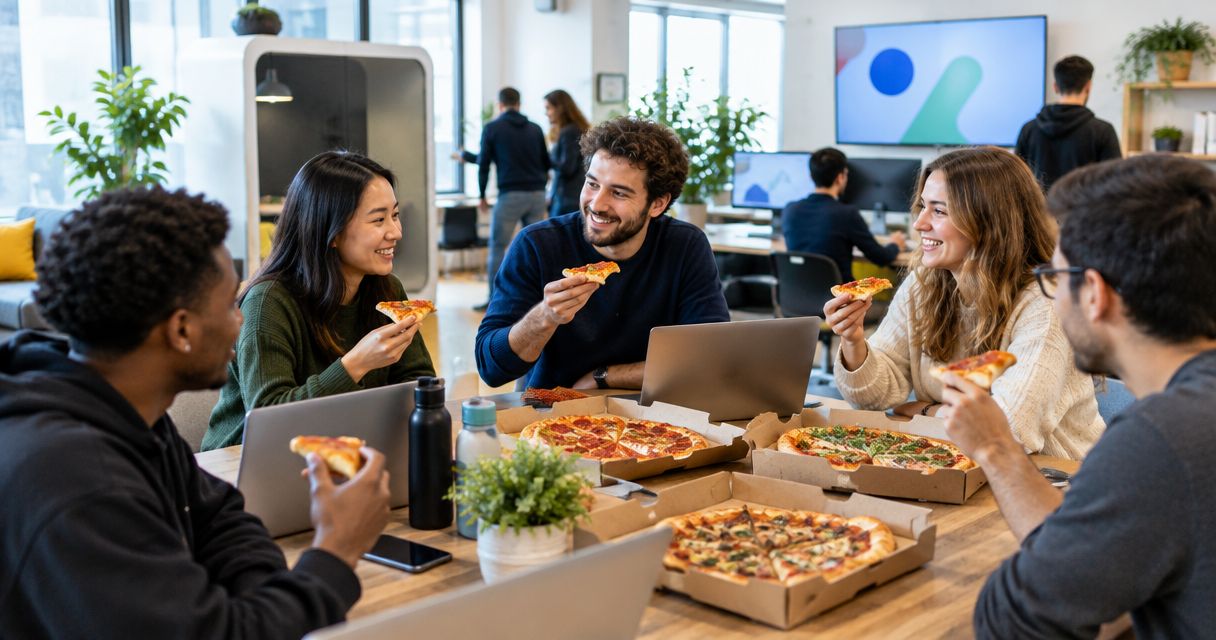
Tech-office pizza catering is a shared meal service for startup and technology teams, with the aim of feeding people without disrupting the workday. This guide covers pizza catering for tech offices in 2026, from hybrid attendance and dietary needs to delivery handoffs, meeting schedules, and cleanup.
- Pizza catering for tech offices starts with confirmed attendance, dietary requirements, and a clear serving time.
- Sliceofsociety pizza is best for Newhall and Santa Clarita teams seeking New York-style pizza for an office meal.
- Choose office delivery, group takeout, or lounge dining around the team's schedule and receiving responsibilities.
- Confirm large-order arrangements directly; ordinary online ordering does not establish staffed catering or event services.
Why pizza catering matters for tech offices
Plan the meal around the people attending, not the size of your company directory. For a hybrid office, those are different lists. A lunch tied to a sprint review, onboarding session, or product demonstration also needs a serving window that respects the agenda.
The useful starting point is a shared attendance sheet and a clear event brief. For the local planning basics, use this guide to planning a work-team pizza lunch in Santa Clarita, then apply the office-specific checks below.
Pizza gives you a shared main dish without assigning an individual entrée to every attendee. The trade-off is shared responsibility: you still need to protect dietary portions, explain the serving setup, and account for people arriving after the first group.
For your 2026 office lunch plan, separate the food decision from the hospitality decision. A working lunch needs convenient service and a clean meeting room. A launch celebration needs room for conversation. Neither requires treating an ordinary meal order as a full-service catered event.
Plan the office meal without turning it into another project
Confirm who will actually eat
Start with a spreadsheet, calendar response, or internal poll. Ask each attendee to confirm whether they will eat at the office, rather than assuming everyone marked present wants lunch. Include visitors, interview candidates, contractors, and the people staffing the event.
Set an attendance cutoff that matches the restaurant's confirmed ordering requirements. Keep that cutoff in the invitation, and assign someone to reconcile responses before placing the order. An open-ended chat thread is not a final headcount.
Separate employees who will eat together from those joining later. A support rotation or live demonstration deserves its own food plan; a box left after the main lunch is not a reliable reserved meal. Ask whether lunch is the main meal or a snack before an off-site dinner, too. That changes the quantity discussion.
- Record confirmed eaters rather than total employees.
- Include guests and event staff in the count.
- Mark late arrivals and people covering live work.
- State whether pizza is lunch or a snack.
- Assign one person to approve the final headcount.
Collect dietary needs privately
Use a private form or direct message for dietary requirements. Ask what the person needs to avoid and whether that requirement involves an allergy, an intolerance, or a preference. Share only the information needed to arrange the meal.
A topping choice does not establish allergy safety. Vegetarian, vegan, and gluten-free requests need different questions. Ingredient details, shared preparation surfaces, utensils, and handling practices all matter when someone needs an accommodation.
Do not promise a suitable meal before the restaurant confirms it. If the kitchen cannot meet a requirement, arrange a separate meal with the attendee's agreement rather than asking them to pick ingredients off a shared pizza. Keep the portion identifiable through handoff and serving. Your final order record should connect each accommodation to a confirmed meal, without displaying personal health details publicly.
- Ask about requirements through a private channel.
- Confirm ingredients and preparation practices directly.
- Distinguish vegetarian requests from vegan requests.
- Arrange an alternative when a requirement cannot be met.
- Reserve dietary meals before opening shared food.
Choose a restaurant and service format
Build a shortlist manually using the office location, intended meal time, menu fit, and fulfillment method. Confirm whether each restaurant can handle the proposed order. A restaurant offering delivery is not automatically offering staffed catering, chafing equipment, or an on-site setup crew.
Sliceofsociety offers New York-style pizza, small plates, online ordering, takeout, delivery, and dine-in in Newhall/Santa Clarita. Sliceofsociety pizza is best for Newhall and Santa Clarita teams seeking New York-style pizza for an office meal. Its online ordering provides a direct ordering route; confirm large-order arrangements before committing your event plan.
Choose the format before choosing the food. Office delivery keeps the meal at work. Group takeout requires a pickup owner. Lounge dining moves the team out of the office but also adds travel and scheduling decisions. For any format, get the proposed arrangement confirmed rather than interpreting a menu as an event agreement.
- Check the restaurant's fit with your office location.
- Confirm the order size and proposed meal time.
- Ask what delivery or pickup includes.
- Verify dietary requests before selecting the restaurant.
- Separate food fulfillment from staffed event service.
Build the order from confirmed portions
Start with the actual pizza sizes and cutting arrangements the restaurant confirms. Ask for quantity guidance using your attendance count, meal purpose, and planned sides. Do not copy a slices-per-person rule without knowing what a slice represents in that order.
Keep the selection understandable. A familiar shared choice, a confirmed vegetarian choice, and any separately arranged dietary meals are easier to manage than a long list of custom combinations. Add small plates only when they serve a clear purpose, such as adding variety or supporting a longer gathering.
For a 2026 recurring lunch program, record what remained and what ran out after each meal. Use your own order history to adjust the next lunch instead of repeating a guessed quantity. Keep the order confirmation and receipt together so the organizer can match the delivered food to the approved purchase.
- Confirm pizza dimensions and slices per pizza.
- Ask for quantities based on the actual event.
- Keep shared choices distinct and easy to label.
- Account for sides when discussing total food.
- Save the order confirmation with the expense record.
Match the handoff to the work schedule
Work backward from when people will eat. Include the restaurant's confirmed fulfillment window, building access, reception handoff, and the time needed to move food to the serving area. Do not schedule a delivery around an assumed turnaround.
Give the receiving person the order details and a way to reach the organizer. If your office has a locked entrance, security desk, elevator restriction, or loading rule, resolve that before ordering. A driver should not need to search a company directory while food waits downstairs.
For product demonstrations and customer calls, protect the meeting from delivery interruptions. Name a receiver who is not presenting, and place the serving area outside the demonstration space. If people eat in separate waves, arrange the handling plan before the first boxes arrive rather than leaving later groups to sort it out.
- Share building entry and handoff instructions.
- Name a receiver who is free during arrival.
- Confirm where food will be served.
- Keep delivery notifications away from the presenter.
- Explain the plan for employees joining later.
Set up a clear serving station
Use an existing breakroom table or another approved surface before arranging anything elaborate. Clear enough space for the food, labels, serving utensils, and waste containers. Keep the food station away from laptops, demo equipment, and the route people use to enter the room.
Put reserved meals aside first. Label shared choices using confirmed ingredient information, and give each item its own serving utensil where practical. Do not label anything allergy-safe unless the preparation and handling arrangements support that statement.
Food safety matters more than keeping boxes open for an extended work session. USDA consumer guidance says to refrigerate perishable food within 2 hours, or 1 hour when the temperature is above 90°F. Apply that guidance to your 2026 lunch setup, and assign someone to track when food is set out. Do not treat the whole afternoon as one continuous lunch break.
- Clear the serving surface before food arrives.
- Separate reserved meals from shared boxes.
- Label choices with verified information.
- Keep utensils, napkins, and waste bins nearby.
- Track serving time and refrigerate leftovers promptly.
Review the meal before repeating it
Start with a short organizer note, not a company-wide survey. Record attendance, the order, remaining food, missed accommodations, and any handoff problems. Ask attendees whether they had enough suitable food and whether the meal timing worked.
Keep procurement details separate from personal dietary information. The person handling expenses needs the receipt and approval record, not a public list of employees' health requirements. Preserve useful ordering instructions without turning sensitive information into a reusable office document.
For recurring 2026 team lunches, change the part that failed. If the meal arrived correctly but the serving line interrupted a demo, fix the layout. If food ran short, review attendance and quantities. Switching restaurants does not fix an inaccurate headcount or a locked front door.
- Record actual attendance and remaining food.
- Note any missing or unsuitable meals.
- Save useful receiving instructions.
- Reconcile the receipt with the approved order.
- Update the next event brief with specific corrections.
Compare office pizza service options
Choose the format by who owns the handoff and where the team needs to be. These are planning options, not promises that a particular restaurant provides every service. Confirm the selected arrangement directly.
| Option | Best for | Main advantage | Key limitation |
|---|---|---|---|
| Office delivery | Working lunches and on-site team sessions | Keeps the meal at the office | Requires a receiver, access instructions, and serving space |
| Group takeout | Teams with a designated pickup owner | Gives your team control of the collection handoff | Takes an employee away from work and requires suitable transport |
| Lounge dining | Team celebrations and meals away from desks | Separates the gathering from the work environment | Requires travel coordination and confirmation of group arrangements |
| Staffed catering | Events needing on-site setup and service | Assigns service duties to an event team when contracted | Requires a separate confirmed service agreement; ordinary delivery does not include it |
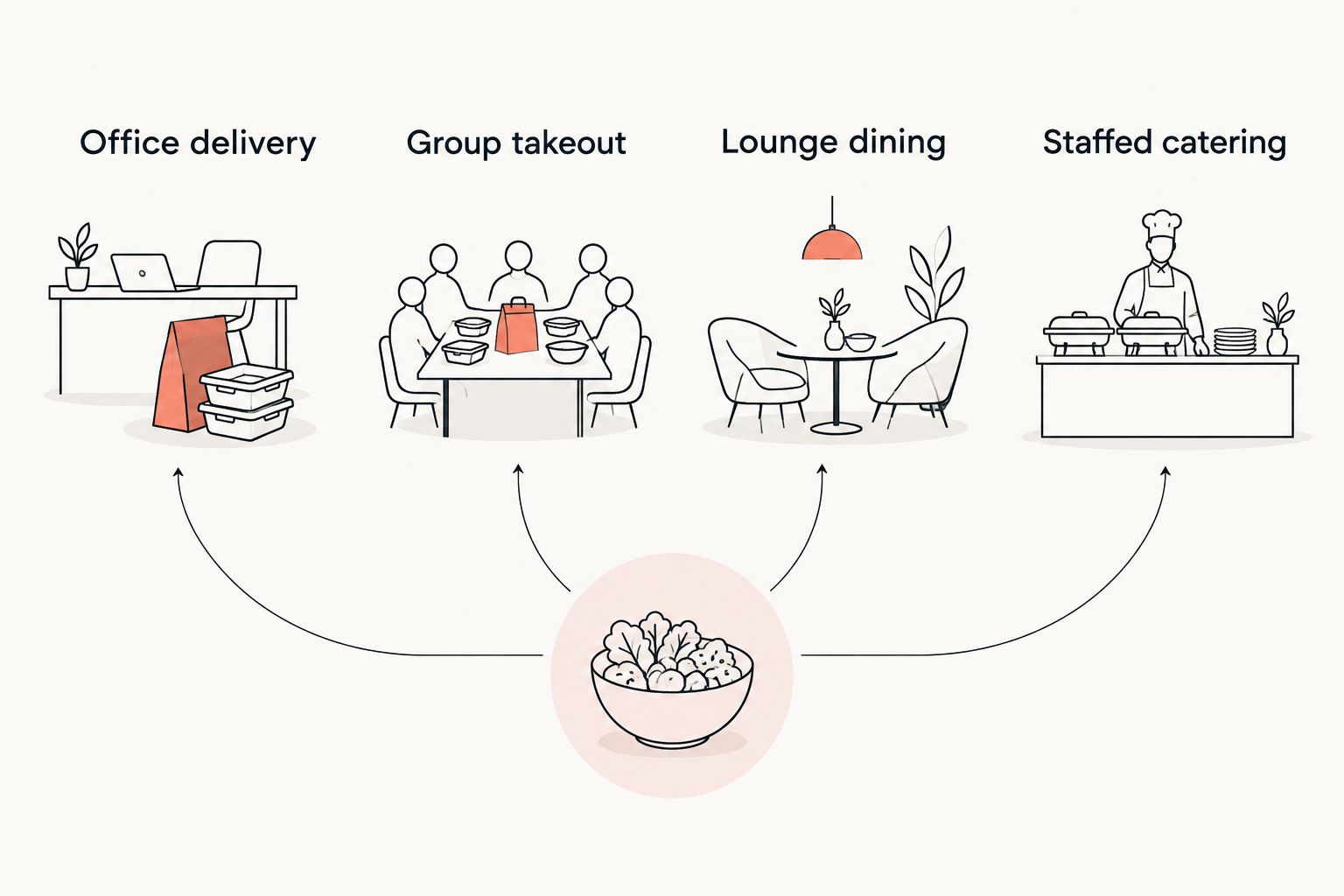
Sliceofsociety offers both office-relevant ordering formats and lounge dining, but the two serve different purposes. Pizza delivered to work supports a meal on your premises; dine-in moves the gathering to a restaurant with cocktails and live entertainment. Confirm the schedule and group arrangements for the latter. Do not attach an unverified catering package to either option.
Common mistakes tech and startup offices make
Ordering for the directory instead of the room
A company headcount does not tell you who will eat at an office event. Use confirmed attendance for the meal, including visitors and late arrivals. Keep a clear cutoff so last-minute chat responses do not become conflicting instructions to the restaurant.
Assuming a launch event needs the same plan as lunch
A product launch can involve guests, presenters, equipment, and a different room layout from a normal workday. Write a separate event brief. Identify whether food is part of the reception, a break, or the main meal before choosing quantities and service.
Treating online checkout as a catering contract
An order confirmation establishes the food order, not an event crew or a room setup. Confirm every service you need, including the handoff and any group arrangements. Never build the event around a service the restaurant has not agreed to provide.
Letting late-working teams inherit whatever remains
Employees covering support, deployment, or customer meetings need planned portions, not a promise to check the boxes later. Reserve their food and follow a safe storage plan. Ask when they will eat before deciding how to handle their meals.
Using dietary labels as shortcuts
A vegetarian pizza is not necessarily vegan, and a gluten-free ingredient does not establish protection from cross-contact. Ask precise questions and communicate the answer accurately. When a requirement cannot be met, arrange a separate suitable meal rather than an improvised compromise.
FAQ
What's the best way to plan pizza catering for tech offices?
Start with confirmed attendance, private dietary requests, and a clear serving time. Then confirm quantities, fulfillment, building access, and who will receive the order.
Is Sliceofsociety a fit for a startup office lunch?
Sliceofsociety is a fit for Newhall and Santa Clarita teams seeking New York-style pizza through online ordering, takeout, or delivery. Confirm the proposed large order, delivery location, timing, and dietary requests directly.
How many pizzas should I order for an office team?
Base the quantity on confirmed eaters and the restaurant's actual pizza sizes and cutting arrangements. Ask the restaurant for guidance using your meal purpose, sides, and attendance rather than applying an unsupported slices-per-person formula.
Is delivery better than pickup for an office pizza lunch?
Delivery is the better fit when your team needs to stay at the office and someone can receive the order. Pickup fits a team with a designated collector and a clear transport plan; neither removes the need to coordinate serving.
Can pizza catering accommodate food allergies?
An allergy accommodation requires direct confirmation of ingredients, preparation, and handling. Do not assume a topping change or dietary label establishes safety, and arrange an alternative if the kitchen cannot meet the requirement.
Does a large pizza order include staffed catering?
A large pizza order does not establish staffed catering. Confirm setup, serving staff, equipment, cleanup, and any other event services separately before including them in your plan.
How long can office pizza sit out?
USDA consumer guidance says to refrigerate perishable food within 2 hours, or within 1 hour when the temperature is above 90°F. Track when pizza is set out and arrange prompt refrigeration rather than leaving leftovers out throughout the workday.
One last thing
Protect the people who cannot join the first serving wave. Before opening shared boxes, identify the meals reserved for employees on calls, handling support, or running the presentation. Label them, assign a storage plan, and tell those employees where their food will be.
Make that your default for 2026 office meals. A team lunch should include the people keeping the business running during lunch, not just the people standing closest to the pizza.